Why Jupiter Island Feels So Exclusive Yet Connected
July 23, 2026
July 23, 2026
If you have ever looked at Jupiter Island and wondered how a place can feel so private without feeling cut off, you are asking the right question. For many buyers, that balance is exactly what makes this stretch of South Florida so compelling. You get a quieter, lower-density coastal setting, yet you are still within a practical drive of everyday services, waterfront dining, and local events. Let’s take a closer look.
Jupiter Island’s sense of exclusivity starts with its scale. The town covers about 1,643 acres at the south end of Martin County, with roughly nine miles of ocean frontage and the Intracoastal Waterway to the west. It also has a relatively small population, with about 820 year-round residents and nearly 2,000 seasonal residents.
That physical setup creates a very different experience from busier coastal markets. According to the town profile, Jupiter Island is a low-density residential community where most land is used for secluded single-family homes and estates, along with conservation and preservation land. Commercial uses are limited and mainly serve residents, which helps keep the overall feel quiet and residential.
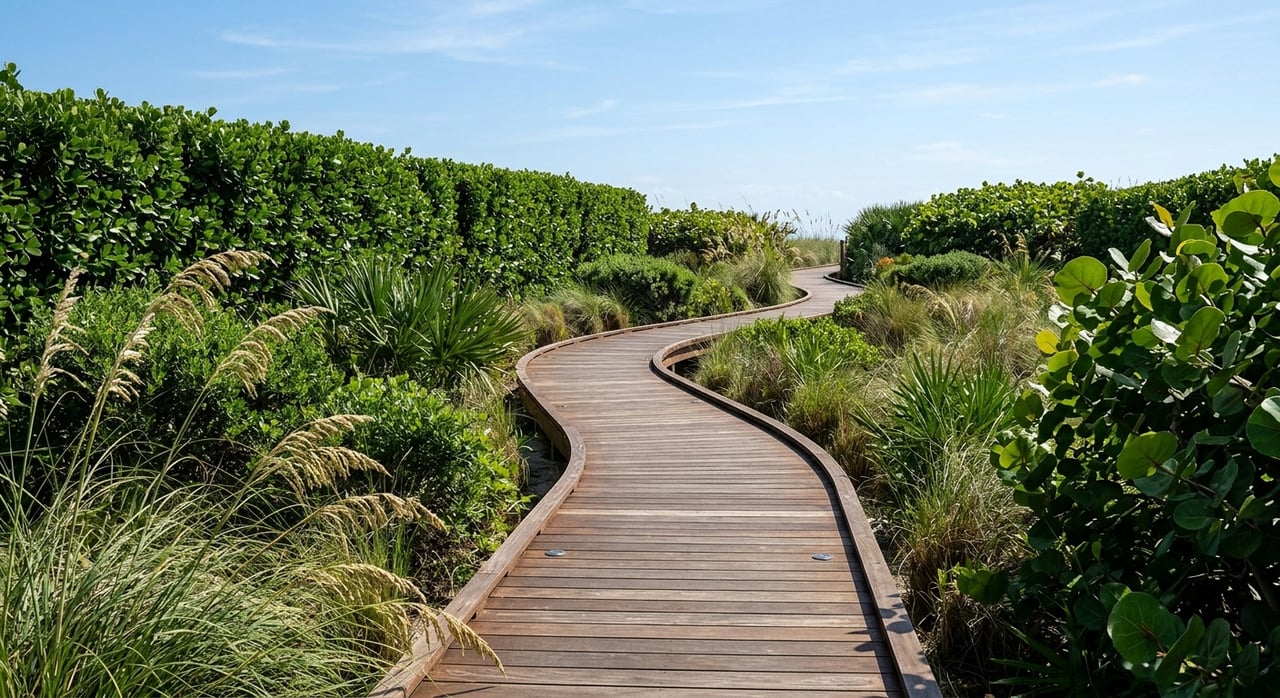
On Jupiter Island, the natural environment is not just scenery. It is part of what defines daily life and long-term character. Preservation decisions over time have helped protect the island from the kind of dense buildout you see in many other waterfront areas.
A strong example is Blowing Rocks Preserve, a 73-acre barrier-island preserve with restored native vegetation, protected beach access, and habitat for leatherback, loggerhead, and green sea turtles. Its history says a lot about the island’s identity. When developers sought rezoning for high-density apartments or hotels, the application was denied, and residents later donated the land for conservation.
That choice still matters today. It helps explain why the island feels spacious, protected, and intentionally low-key rather than heavily commercialized.
Jupiter Island’s beach policies also play a role in how the area feels. The Jupiter Island Beach Protection District exists to protect beaches and adjacent lands from erosion and storm damage. The town also prohibits driving on the beach.
Taken together, those policies support a shoreline experience that feels more preserved and less crowded by vehicle activity. For buyers, that often translates into a stronger sense of privacy and natural separation.
The nearby Nathaniel P. Reed Hobe Sound National Wildlife Refuge adds another layer to the island’s character. The refuge says it contains the largest contiguous section of undeveloped beach in southeastern Florida and one of the most productive sea turtle nesting areas in the southeastern United States.
That matters because it reinforces a feeling that the landscape still leads here. Even in a luxury market, the setting remains shaped by open shoreline, habitat protection, and limited intensity of use.
Privacy is only part of the story. Jupiter Island also works because it is not isolated in the way some buyers might assume. Its connectedness is just more focused and intentional.
Access runs through a few important corridors rather than a wide web of roads. That gives you practical connections to the mainland while preserving the island’s quieter feel.
In Martin County’s Hobe Sound CRA plan, Bridge Road is described as the sole east-west connector through Hobe Sound and the primary regional connection from Jupiter Island to I-95, about seven miles to the west. In real terms, that makes Bridge Road one of the main pathways between the island and many mainland destinations.
The same local planning documents describe Bridge Road as Hobe Sound’s main-street commercial corridor. They also identify US-1 as the north-south spine of local travel. So while Jupiter Island may feel tucked away, nearby access to shopping, services, and regional travel is clear and straightforward.
Another reason Jupiter Island feels exclusive is that access is concentrated. Palm Beach County’s bridge listing identifies the Jupiter Island drawbridge on SR-707 as an on-demand drawbridge.
That bridge-based access pattern is important. It means entry onto the island happens through a limited set of crossings rather than through sprawling road networks, which naturally supports a more contained and private atmosphere.
Even the utility network reflects that balance between separation and connection. Jupiter Island’s community profile notes that South Martin Regional Utility provides water and wastewater service on both Jupiter Island and the Hobe Sound mainland.
That is a useful reminder for buyers. The island may feel distinct, but it remains tied into a broader local infrastructure system that supports day-to-day living.
A big part of Jupiter Island’s appeal is that you do not need the island itself to carry every restaurant, shop, or event venue. Nearby Jupiter and Hobe Sound fill that role.
This is one of the clearest reasons the area feels connected rather than remote. You can enjoy a more private home setting while still being near active waterfront and main-street destinations.
Martin County’s Hobe Sound CRA materials explain that the goal is to reinforce small-town character by making Bridge Road a business-friendly and pedestrian-friendly main street. The CRA plan also says essential retail services and commercial activity cluster along Bridge Road and US-1.
For Jupiter Island residents, that means many practical needs are handled nearby on the mainland. The convenience is close, but it is not layered directly into the island’s residential setting.
To the south, Jupiter offers a different type of amenity base. The town’s Riverwalk runs along the Intracoastal Waterway from Jupiter Ridge Natural Area to the Jupiter Inlet and provides public access, wildlife viewing, marina access, dining, retail, and public events such as art and craft fairs, holiday celebrations, music and dance, and food festivals.
Harbourside Place, part of the Riverwalk system, includes restaurants, retail, an amphitheater, public boat docks, parking, and a hotel. In practical terms, that gives the greater area a compact waterfront center for dining and entertainment.
For many luxury buyers, the question is not whether Jupiter Island is exclusive. It clearly is. The better question is what kind of exclusivity it offers.
Here, exclusivity comes from low density, preserved land, limited commercial intensity, and concentrated access. At the same time, connectedness comes from bridge crossings, nearby mainland service corridors, and amenity hubs in Hobe Sound and Jupiter.
That trade-off can be very appealing if you want privacy without giving up convenience altogether. You are not choosing total isolation. You are choosing natural separation with practical access to the things that support your lifestyle.
If you are comparing high-end coastal communities, Jupiter Island stands out because it does not try to be everything in one place. It stays residential, low-density, and conservation-minded, while relying on nearby corridors and neighboring towns for much of the dining, retail, and event activity.
For the right buyer, that is the appeal. You get a more protected and private coastal environment, yet the broader Jupiter and Hobe Sound area remains close enough to keep daily life convenient.
If you are thinking about buying or selling in this part of the market, local context matters. The team at Hughes Browne Group can help you understand how Jupiter Island fits into the wider coastal landscape and what that means for your goals.

Whether by land or by sea, the properties and amenities in South Florida are of the highest quality, and this group of Real Estate Agents certainly follows suit.